Think twice before bringing these into your next home makeover.
As 2025 winds down and everyone begins planning fresh upgrades for the new year, it is natural to start pinning ideas, browsing catalogues, and shortlisting tiles. But before you commit to anything, it helps to know which trends are officially losing favour with Indian interior designers in 2026.
Whether you are revamping a bathroom, opening up a kitchen, or simply refreshing an older layout, avoiding outdated trends can save time, money, and future regret. We spoke to leading Indian designers about what they are saying goodbye to in 2026, and what to embrace instead.
1. Plain Smooth Walls
For years, flat, builder finish walls dominated modern Indian homes. Not anymore.
“Smooth drywall tends to feel flat and lifeless,” says Bengaluru based designer Jennifer Cataldo of Maison Cataldo. “People want homes that feel warm, handcrafted, and full of personality.”
Indian homeowners are increasingly choosing:
- Limewash textures
- Venetian plaster
- Hand trowelled finishes
- Subtle grain surfaces that reflect natural light
- Traditional Indian-inspired textures like oxide finishes or Jaali shadows
These surfaces add quiet depth and movement to a room, instantly elevating even a minimalist space. The shift reflects India’s growing preference for artisanal, handmade finishes over mass-produced flatness.
2. Waterfall Kitchen Islands
The marble waterfall island once signalled luxury in Indian homes, especially in modern apartments and luxury villas. In 2026, however, designers are moving on.
“Kitchens today need to feel inviting, not museum-like,” says Cataldo. “Waterfall islands look repetitive now.”
What designers prefer instead:
- Mixed material islands with wood and stone
- Curved or sculpted edges
- Islands with open shelves or furniture-inspired legs
- Warm metals like brushed brass or antique bronze
- Stone tops that do not extend vertically down the sides
“The new luxury kitchen in India is more tactile and layered,” she adds. “It is about subtle richness, not drama.”
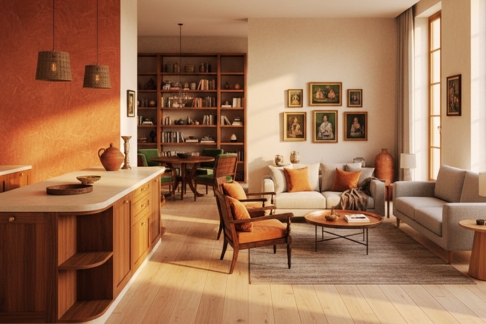
3. Blonde Oak Everything
Light blonde oak became a favourite in Indian homes because it brightened compact spaces. But in 2026, deeper, moodier tones are taking over.
“We want contrast and visual weight,” says Tennille Burnup of Tennille Joy Interiors. “Think of your grandmother’s teak showcase or a rich walnut console.”
Designers are bringing back:
- Walnut
- Indian teak
- Mahogany tones
- Amber mid-tone woods
- Cane paired with deeper wood stains
These richer tones give rooms an elevated, timeless feel especially suited for Indian décor, which often uses warm undertones.
4. Matching Everything
Matching furniture sets used to be a go-to for quick styling: same wood finish, same cushions, same colour palette. But the overly coordinated look is on its way out.
“Indian homeowners want character now,” says Burnup. “A perfectly matched space feels like a staged sample flat, not a personal sanctuary.”
Instead, designers recommend:
- Mixing old and new pieces
- Pairing metals with woods
- Blending Indian artisanal decor with contemporary pieces
- Layering textiles from different regions
- Combining different eras and silhouettes
The rule for 2026 is simple: curated over coordinated.
5. Fake Scandi
Minimalist Scandinavian design has been trending in India for years, but much of what is sold as “Scandi” here is mass-produced and far from the original philosophy.
“True Scandinavian design is functional, restrained, and thoughtful,” says Alyssa Anselmo of Anva Studio. “The fake Scandi trend strips all the soul out of minimalism.”
The imitation trend is fading fast as Indian homeowners realise that minimal does not mean sterile.
What to embrace going forward:
- Clean but warm minimalism
- Real wood instead of laminate
- Pieces with honest craftsmanship
- Neutral palettes balanced with Indian textures
- Functional forms that age well
Homes in 2026 are moving toward intentional simplicity, not catalogue inspired copy-paste décor.
Final Thoughts
Indian design in 2026 is leaning toward warmth, craftsmanship, and individuality. Instead of chasing trends, homeowners are choosing materials and layouts that feel personal, functional, and timeless.
The idea is simple: create a home that grows with you, not a home designed to impress visitors for a season.